
'I could see it not having any impact whatsoever,' says Stephen P Cohen on Obama's India visit.

Clearly, LoCs are becoming a key arrow in India's economic diplomacy quiver.
'Obama's visit to Hiroshima must generate a fresh debate in the international community about how to reduce the salience of nuclear weapons in international politics and how to disarm the world from these monstrous weapons forever,' says Sanjeev Shrivastav..
'India showcased its ability to launch multiple Special Forces strikes simultaneously across a well defended front.' 'Through these strikes Pakistan was given a glimpse of the full range of India's military capabilities,' says Brigadier Gurmeet Kanwal (retd).

'The Russians? had risen to great heights of sacrifice and heroism and won a victory against Hitler and Nazism at such a tremendous cost in spite of being weighed down by the tyranny and oppression of Stalin.'

In spite of irritants and hiccups in the relationship, a few deliverables are expected of the prime minister's visit to China, says Rup Narayan Das.

20 years ago this day, May 11, 1998, India conducted its second nuclear test at Pokharan in Rajasthan. In a fascinating interview on Rediff.com, K Subrahmanyam revealed how Indian PMs reacted to nuclear ambitions.
'Whichever option India chooses, it should be clear to the government that the China-Pakistan nexus poses a clear and present danger to national security,' says Brigadier Gurmeet Kanwal (retd).

'When the youth population is so large, in a globalised world, they look for opportunities. Are there enough opportunities for the youth in India?' 'The idea of affirmative action has to be creating capability. All individuals have potential. Unfortunately, there is capability deprivation because of the State's inaction.' 'Nation building has been a disaster in India mainly because we lacked the work ethic compared to the US and European countries.'
Prime Minister Narendra Modi promised a conducive environment for manufacturers, including a discrimination-free tax system

'While China expressed reservations on the Indian role in the South China Sea, Beijing threw to the winds Indian concerns on Kashmir by announcing $46 billion in investments Pakistan occupied Kashmir,' says Srikanth Kondapalli.

Trade between India and Indonesia stands at $20 billion.

'Did the government learn any lesson from the disasters of 2008, 1987, 1975?' 'Certainly not!' 'They are making people believe that the 2017 flood was unexpected, so no preventive effort towards reducing the loss of human lives was to be expected from the government,' says Mohammad Sajjad.

'India was in no position to wage another war in 1965, having suffered a morale-shattering defeat in 1962. The three services were in the middle of a modernisation and expansion phase and therefore not fully trained or battle-ready.'

'Until India fully absorbs the fundamentals of international relations, it will continue to get evil for good,' says Brahma Chellaney.

'If Indian armed forces entered Pakistan and succeeded in inflicting major damage on the Pakistani army and occupied territory in the Pakistani heartland, there is reason to think the Pakistani military would use some nuclear weapons against the incoming Indian forces to compel India to stop.'

'My simple instruction to every IBM salesperson is, "When you go to the customer, use less of this (he points to his mouth) and more of this (ear)".' 'Talk less, listen more",' Karan Bajwa tells Raghu Krishnan.

'In the past the US has been reluctant to name Pakistan directly in an US-India joint statement.'

The Border Defence Cooperation Agreement with China needs closer scrutiny, says Rup Narayan Das.
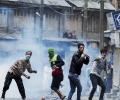
'Burhan Wani's killing served as a spark for the anti-establishment fire that has been raging in the minds of Kashmiris ever since the Centre stopped engaging them for their political future,' says Air Vice Marshal (retd) Kapil Kak in an interview with Rediff.com
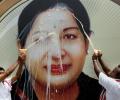
'The irresistible charm of Indian politics is it can always throw up surprises -- even when it looks as predictable as in Tamil Nadu,' discovers Shekhar Gupta.

'They don't always agree with our governments, their teachers or their parents, but it is the conviction of their ideas, and their determination to share them with the world that, I believe, is one of the greatest sources of hope for our planet.' 'The colonisation of space, understanding the very building blocks of matter and the universe, utilising our understanding of the human genome to conquer disease -- these are the tasks waiting for a fellowship of minds to realise new triumphs in our collective destiny.'
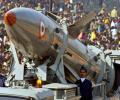
It is time the new government, unencumbered with the burden of past, initiates a wide ranging review and open debate on the security issues to rectify our short term and long term shortcomings. It has taken some wise steps but has to go beyond this to identify the structural weakness and create systems, says Colonel (retd) Anil Athale.
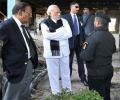
The Indian Army and more recently the Indian Navy have already set up dedicated intelligence branches. It is surprising indeed that the IAF, where real time and timely intelligence is most vital for effective and safe prosecution of the air war, has still not done so itself, says Group Capt (retd) P I Muralidharan.

Prime Minister Narendra Modi had gone to China with a bagful of initiatives, but not all seems to have been fulfilled given China's reluctance to go the whole hog with him
'After General Raheel Sharif took on the Tehrik-e-Taliban Pakistan, some sections of the military establishment may have felt unease as to whether the crackdown could be extended against friendlier 'non-State' actors like the Lashkar-e-Tayiba.'

India has made a good beginning in the area of satellite navigation but still there is a long way to go.

With Sundar Pichai becoming the CEO of Google, India has one more reason to cheer its prowess in the global IT sector.
'If his three priorities are the economy, the economy, the economy, then there is need for a stable region, a stable neighbourhood.'
The average Indian soldier remains as hardy as before but he is certainly confused with the pace of change occurring all around him. It is here that the leaders -- the officers -- will have to adapt themselves to the new reality, says Nikhil Gokhale

Prime Minister Narendra Modi's visit to Myanmar is aimed at transforming the arch of Bay of Bengal into the Circle of Southeast Asia, says Anirban Ganguly.
China wants a code of conduct for troops on the India-China border areas. While the Indian side has reacted cautiously, it is not clear what effective additional protocols that the current proposed code will bring forth to usher stability in the border areas, says Srikanth Kondapalli.
A sensational interview on India-China ties, with the man most qualified to answer.

'The message to India is (with attacks like Pathankot) basically what the Pakistani army is trying to test is how serious are you when it concerns the peace process with that country.'
.jpg)
The buck for the Gandamal tragedy should not stop with the school-in-charge Meena Kumari. She is just the face of a deeper malaise in Bihar, says Apoorvanand.

Dr Manmohan Singh would be faced with very few choices in Beijing given the Chinese conceived notions of the world today and India's low place in their calculus, says Srikanth Kondapalli.

Amid a spurt in terror attacks in various countries, Prime Minister Narendra Modi on Thursday said terrorism is the "gravest threat" to the world, "equally impacting" India and Mozambique which agreed to strengthen security and defence ties and bolster cooperation in food security.
'You cannot judge a government within a month. Give us five years' time.' 'At times, strict economic decisions have to be made for the good of the poor in the long run.' Dharmendra Pradhan, one of the Modi government's stars, speaks exclusively to Sheela Bhatt/Rediff.com about why the government is forced to roll out 'bitter medicine.'

President Pranab Mukherjee on Monday addressed the first joint sitting of Parliament as mandatorily required under the Constitution after the general elections. The address is the political, economic and foreign policy road map of the Narendra Modi government and covers virtually all crucial areas.
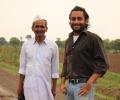
Shuvajit was confident of making a huge difference in the lives of people in rural India.
